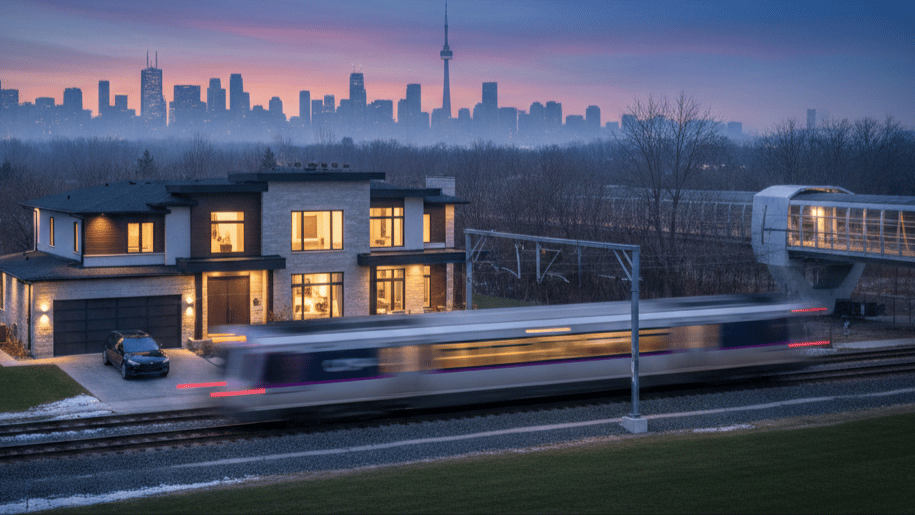
The Metrolinx GO Expansion is a primary driver for property appreciation near Oakville GO, with 2026 home values projected to see a 4% to 8% premium over non-transit-aligned neighborhoods. As the Lakeshore West line moves toward 15-minute two-way, all-day service, proximity to the station has transitioned from a convenience to a "critical asset," insulating local prices against broader market volatility and attracting high-net-worth commuters.
The Deep Dive
As we move through 2026, the real estate narrative in Oakville is increasingly defined by "Transit-Oriented Divergence." While the broader GTA market has reached a state of strategic equilibrium, properties within a 10-to-15-minute walk of the Oakville GO station are outperforming the municipal average. This is not merely due to shorter commute times to Union Station; it is a result of the massive infrastructure "enabling works" including track electrification and the Burloak Drive grade separation which signify a permanent shift toward an urbanized, high-frequency transit model.
This "uplift effect" is most visible in the freehold and luxury segments. Buyers in 2026 are prioritizing properties that offer a "future-proofed" lifestyle. As Metrolinx nears its goal of nearly 10,000 weekly trips across the network, the demand for executive homes in South Oakville and modern townhomes in surrounding pockets has surged. Investors and end-users alike recognize that as the Lakeshore West corridor becomes more efficient, the land value surrounding these hubs becomes a finite, appreciating commodity.
Local Nuance: The Midtown & Glen Abbey Connection
The impact is particularly acute in specific Oakville micro-markets:
-
Midtown Oakville: This 100-hectare revitalization zone surrounding the GO station is transforming from a commercial-industrial hub into a high-density residential anchor. Current 2026 data shows that properties in the Midtown catchment are maintaining higher price floors due to the Official Plan Amendment allowing for increased intensification.
-
Glen Abbey & College Park: These established neighborhoods are seeing renewed interest from "lifestyle-first" professionals. With the $1.5 million insured mortgage cap fully implemented, buyers are aggressively targeting these districts to balance elite school rankings with seamless 15-minute rail access.
-
Infrastructure Connectivity: Local projects, such as the widening of Wyecroft Road and improved pedestrian bridges across the rail corridor, are enhancing the "walkability score" of nearby homes, a key metric for 2026 valuation.
Key Value Drivers in 2026
-
Frequency Premium: Houses near stations with 15-minute service frequencies typically command a 6% to 9% higher price point than those requiring a bus transfer.
-
Infrastructure Certainty: The completion of major "on-corridor" works in late 2025 has removed the "construction noise discount," leading to a price bounce-back for homes backing onto the rail line.
-
Reduced Inventory: The scarcity of freehold land near the Oakville and Bronte GO stations ensures that even in a balanced market, bidding wars remain common for move-in-ready assets.
Ready to Capitalize on the Oakville Transit Boom?
The Metrolinx expansion is more than just a transit upgrade; it is a fundamental shift in how Oakville real estate is valued. As the Lakeshore West corridor evolves, the window to acquire or sell assets at peak strategic advantage is narrowing. Whether you are curious about the current equity in your South Oakville home or looking to diversify your portfolio near the Midtown Oakville revitalization, we provide the data-driven precision you need to win.
Contact Martin Group today to discuss your 2026 real estate goals and ensure you are positioned for maximum ROI.
Profit from our experience.