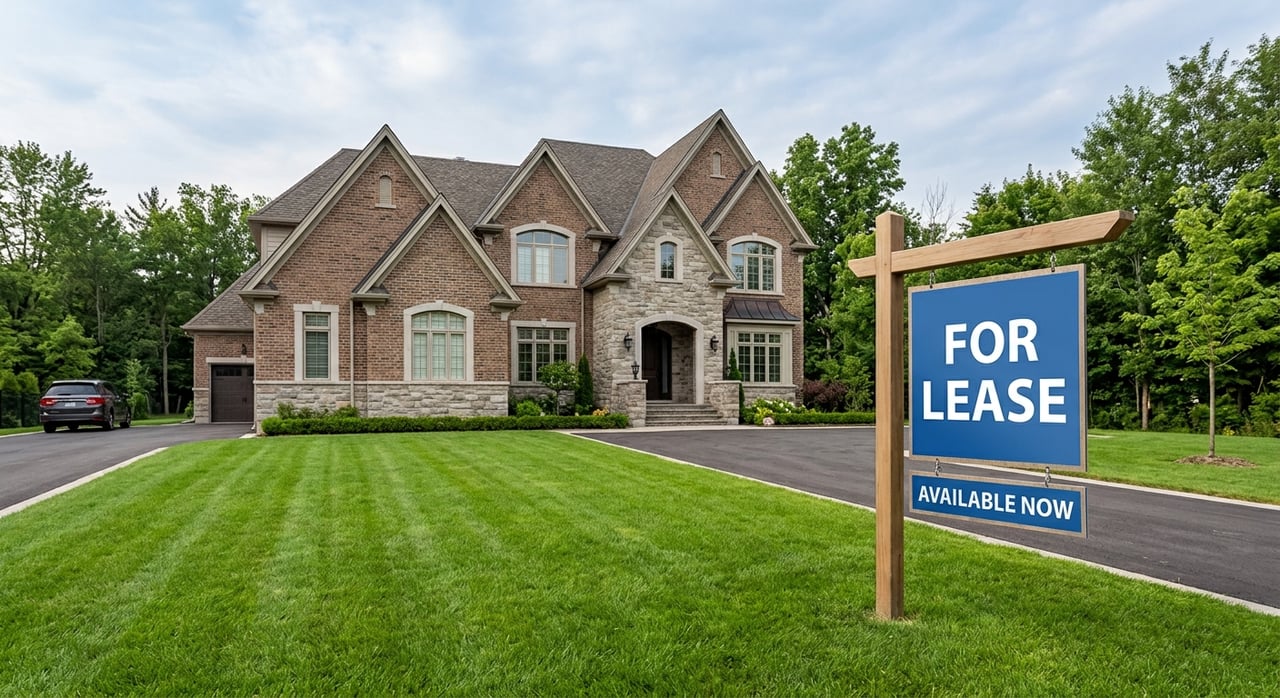
Two Oakville headlines are true at the same time this year, and they should not both be true. Detached home sales in Oakville jumped more than 30 percent in August 2026 compared with the same month last year. Over that same stretch, both the average and median sale price for a detached home slipped. More people bought homes. The homes they bought cost less, on average, than they did twelve months earlier.
If you're used to reading real estate the way most people do, that reads as a contradiction. Usually rising sales and falling prices don't travel together. A market either heats up on both fronts or cools on both. Oakville is doing neither, and the reason has less to do with buyer sentiment than with a financing rule that changed exactly two years ago and is only now fully working its way through the town's price ladder.
The Numbers Don't Add Up the Way You'd Expect
Here's what a side-by-side comparison of Oakville's detached-home market looked like in August 2026, year over year:
| Metric | Year-over-year change |
|---|---|
| Detached home sales | Up 32.6% |
| New listings | Up 41% |
| Active listings | Up 31.6% |
| Months of inventory | Down slightly, holding near 6.1 |
| Sales-to-new-listings ratio | Flat, near 33% |
| Average sale price | Down 7.6% |
| Median sale price | Down 3.2% |
If demand had genuinely softened, that sales-to-new-listings ratio would have dropped too. It didn't. Buyers are still absorbing roughly a third of what comes onto the market, the same pace as a year ago. What changed is that both sides of the equation, buyers and sellers, showed up in bigger numbers at once. Sellers listed faster than usual. Buyers bought faster than usual. And because supply grew slightly ahead of demand, the price a typical buyer paid came down even as the number of buyers went up.
That's a supply story wearing a price-decline costume. It matters which one you think you're looking at, because the two call for opposite strategies if you're the one listing a home or writing an offer.
The Rule That Quietly Redrew Who Can Afford a Detached Home Here
In December 2024, the federal government raised the price ceiling for an insured mortgage from $1 million to $1.5 million. That single change matters more in Oakville than in almost any other Canadian market, because Oakville's typical resale price sits right in that band. Oakville home sales in February 2026 closed at an average price of roughly $1.3 million, with the median closer to $1.18 million, both squarely inside the newly insurable range.
Before the change, a buyer purchasing a $1.2 million home needed roughly $240,000 down to avoid the uninsured mortgage bucket. After it, the same buyer can put down closer to $95,000 and still qualify for an insured mortgage, according to TD Economics' analysis of the policy. That's not a modest tweak. It's the difference between a purchase that requires two years of extra saving and one that doesn't.
Mortgage insurers have watched the effect show up in their own books. Canada Guaranty's president and CEO said earlier this year that GTA business, which represented about 6 percent of the company's total volume before the change, has since climbed to 15 to 16 percent. That's not a rounding error. It's a structural shift in who can walk into a bidding conversation on a home that used to be out of reach without a much larger down payment.
Where the Effect Shows Up Street by Street
The mechanism is easiest to see in the neighborhoods where freehold homes dominate the resale mix. In one Oakville pocket tracked closely through the spring, June 2026 brought only 17 sales against 60 new listings, a sales-to-listings ratio near 28 percent, with freehold properties accounting for 14 of those 17 closings. Inventory in that same area sat at 5.1 months, well above the 3 to 4 months that typically signals a balanced market, and had held there for more than a year.
That's the pattern playing out across Oakville more broadly too: inventory hovering in the 5.5 to 6 month range for months running, comfortably in buyer's market territory, even as sales counts climb. The insured-mortgage change opened the door for a wave of qualified buyers to step into the $1 million to $1.5 million range at the same moment a wave of sellers, sensing the shift, decided this was the year to list. Buyers got there first in raw numbers, but not by enough to push the sales-to-listings ratio, or prices, upward.
What This Means If You're Selling
The math here rewards precision over optimism. A larger, financing-qualified buyer pool sounds like leverage for sellers, and in a narrow sense it is. But that pool is currently facing more competing listings than it has in recent memory, which means a home priced even slightly above where recent comparable sales have landed risks sitting through showings while a better-priced neighbor closes first.
A few things worth doing before listing in this environment:
- Price against the median for your specific home type and area, not the average, since the average is being pulled by the mix of what's selling rather than a clean read on value.
- Expect more of the buyer pool to be financing-sensitive. A buyer using an insured mortgage in the $1 to $1.5 million range is watching their monthly payment closely, and presentation that reduces perceived renovation risk tends to matter more than usual.
- Don't assume rising sales volume alone justifies a premium ask. The sales-to-listings ratio, not the sales count, tells you whether you have real pricing power right now.
What This Means If You're Buying
If you've been priced out of Oakville's detached market by the size of the down payment rather than the mortgage payment itself, this is the policy that changed your math, and it's still in effect. A buyer with less than 20 percent down now has a real path into homes that used to require the full uninsured down payment.
That access comes with a tradeoff worth modeling before you get attached to a number. A smaller down payment means a larger mortgage balance and an insurance premium added to the loan, and it means less equity cushion if your household income or the local market shifts. TD Economics' own read on the policy noted that a buyer putting down the new minimum on a $1.05 million home still needs a household income in the $170,000 to $180,000 range to qualify under typical debt-service rules, which keeps this a mid-market unlock rather than an entry-level one.
A Few Questions Worth Asking Before You Act
Does falling prices mean Oakville is due for a bigger correction? Not necessarily. Months of inventory near 6 has held for over a year without triggering a steep decline, because the sales-to-listings ratio has stayed roughly steady. A real correction would show that ratio dropping, not the price ticking down while transaction counts climb.
Will this financing effect fade? TD's own modeling suggested that by the end of 2026, the affordability lift from the mortgage rule changes will have eaten away at the initial boost to sales, leaving prices only marginally above where they would have landed without the policy. If that holds, the sales surge is more front-loaded than permanent.
Should I wait for prices to drop further before buying? That's a decision that depends on your own financing, timeline, and household budget, and it's worth working through with a mortgage professional rather than timing a market snapshot. What the data does tell you is that the current combination of high inventory and insured-mortgage access is a specific, dated window, not a permanent condition.
If you're trying to figure out what any of this means for a specific street or a specific offer, that's where local numbers stop being a headline and start being a decision. Martin Group works Oakville's resale market street by street, and a Free Home Valuation is the fastest way to see where your own situation sits against the data above.